Be Cited.
Be The Answer.
We measure whether AI systems can reach your pages, find the answers inside them, and are willing to name you — then resolve whichever of those three is failing. Most of the time, it is the first one, and almost nobody is looking there.
Founded by Chuck Morrison — 33 years of brand building, go-to-market and PR, applied to the systems that now answer for you.
Test buyer prompt sets across tracked categories
Select a representative buyer query below to inspect how AIGNCI maps retrieval share, citation provenance, and missing corroboration across ChatGPT, Perplexity, and Google AI Overviews.
Estimate invisible buyer drop-off from uncorroborated AI answers.
Based on your monthly search query volume, AIGNCI's 3-gate model calculates estimated revenue diverted to competitors due to Gate 1 (Reach) and Gate 3 (Cite) failures.
You already leave sites that will not let you in. Machines do the same thing, faster, and they never tell anyone.
A page will not load, so you go back. It loads, but the answer is buried, so you go back. You do not file a complaint — you pick whoever answered first.
When you give up, nobody hears about it. When a machine gives up, it still delivers an answer — somebody else's. Three gates decide whether that answer names you, and they open in order.
A security or performance layer turns the automated reader away — often while reporting success, so it never shows up as an outage.
The answer is there, written well, in ordinary paragraphs with no labels around it. A machine cannot lift it out, so it quotes somebody who labeled theirs.
The claim appears only on your own website, with nothing anywhere else to corroborate it. An uncorroborated claim is quietly dropped.
The gates are sequential, and that is the whole point. Better writing cannot rescue a page a machine was refused. Most companies are investing at gate three while failing at gate one.
Which gate is failing?
The gate that is costing you money is usually not the one you are working on. Below are the six symptoms organizations actually describe when they call, each mapped to the gate that produces it and the inspection that would confirm it.
This is the signature of an answer engine satisfying the question without sending the click, and it is the one case where nothing is wrong with your site at all. It is also the case most often misdiagnosed as an SEO problem and treated with more content, which does not address it.
How you would confirm itCompare impressions against clicks over eighteen months. Flat impressions with falling clicks is answer substitution; falling impressions is a ranking problem, and the two require opposite responses.
The most common finding in this practice, and the most expensive. A security or performance layer is refusing automated readers while serving humans normally — so the page is flawless in every browser you test and absent from every model that tried to read it. Nothing at the later gates can compensate, because the content was never received.
How you would confirm itRequest your own pages with each AI crawler's user agent and compare the response body against what a browser receives, byte for byte. A 403, a challenge page, or an empty container is the answer.
Volume is not the currency. A machine has to be able to lift a specific answer out of a specific page and attribute it to you. Well-written prose with the answer in the fourth paragraph and no structure around it loses to a competitor who labeled theirs, every time.
How you would confirm itTake twenty real buyer questions and check whether each answer appears within the first hundred words of a page, under a heading that matches the question, inside markup that declares what it is.
Content that requires an interaction to appear is, to most retrieval systems, content that does not exist. This applies to accordions, carousels, tabbed specifications and anything injected after the initial response — a category that includes a great deal of otherwise excellent design work.
How you would confirm itView source rather than inspecting the rendered element, or fetch the page with JavaScript disabled. If the text is not in the response body, it is not in the index.
Entity resolution has failed. Nothing tells the model that your legal name, trading name, prior name and several properties refer to one organization, so it is holding two or three partial records and answering from whichever is most repeated — often the outdated one.
How you would confirm itCheck whether your Organization markup declares legalName, alternateName and a sameAs array pointing at the same external references your other properties cite. Mismatched sameAs values across your own sites is the usual culprit.
An uncorroborated claim is quietly dropped. Models favor what is repeated across independent sources, which means a genuine differentiator that appears only in your own marketing is functionally invisible — not disbelieved, simply not carried.
How you would confirm itSearch your strongest claim as a phrase and count the independent domains that state it. If the answer is one, and it is yours, that claim is not available to be cited.
A symptom narrows the search; it does not close it. Each inspection above is one you can run yourself, and the audit exists because running all of them across an estate is a week of work rather than an afternoon.
How the gates workSearch stopped sending traffic and started giving answers.
When an AI summary appears, click-through on the results below it falls from roughly 15% to 8%, and about a quarter of those sessions end without a single click. The traffic did not move to a different channel. It stopped existing.
What replaced it is narrower and far more valuable: a machine naming a small number of brands as the answer. Being one of those names is now the whole game, and the signals that earn it are not the signals that earned rankings.
Backlink volume and total traffic correlate negatively with AI citation. A decade of accumulated SEO authority does not transfer automatically. That is the opening.
The Citation Engine.
Full documentationMap
What is your buyer actually asking a machine?
AIGNCI builds a set of 50–200 real buyer questions and runs them across ChatGPT, Perplexity, Gemini, Claude, and Google AI Overviews. You get a baseline: where you are cited, where you are merely mentioned, and who is recommended instead of you.
Ground
Can machines read you, and do they know who you are?
Crawler access, render path, schema graph, entity disambiguation. Most sites fail here invisibly — blocked AI user agents, JavaScript-only content, canonical tags pointing at the wrong domain. This stage is unglamorous and decisive.
Structure
Is your content shaped the way machines extract?
Question-phrased headings, answer-first blocks, self-contained semantic chunks, comparison content, statistic density. Comparative and list-format pages account for 25.4% of all AI citations. Homepages account for 3.3%.
Corroborate
Do other sources agree with you?
Answer engines synthesize consensus. Building consensus means earned mentions, digital PR, communities, reviews, partnerships, and talent — the discipline our founder has practiced since 1995. This is the stage most technical agencies underweight.
Compound
What changed this month?
Between 40% and 60% of AI citations change monthly. AIGNCI re-measures against the fixed prompt set, tracks share of answer against named competitors, attributes AI referral traffic, and refreshes content when a citation is lost.
GEO does not replace SEO. It sits on top of it. Any agency telling you otherwise is selling a rebrand of the same retainer.
Start with the reason you are not cited.
The AEO, GEO & Citation Audit Report shows where a brand fails the Reach, Read, and Cite tests—and what deserves action first.

33 years of brand building.Now engineered for AI search.
Answer engines do not rank pages. They synthesize consensus about who is credible — which makes this a reputation discipline wearing a technical costume. Building consensus across earned media, partnerships, talent, and press is not a new problem. It is the oldest problem in marketing.
Chuck Morrison has led that work since 1995. AIGNCI brings three decades of brand building, go-to-market, and PR experience to the AI systems that now determine who gets named, cited, and chosen.
Brand building, go-to-market and PR since 1995 — four companies founded, three exits.
Including a franchise network taken to $35M in annual sales and 70% of its category.
National campaign work for category leaders, plus 60+ music placements in network television.
The work has a public trail.
Four clients. Named, current, verifiable.
All case studiesThe Wellness Agency
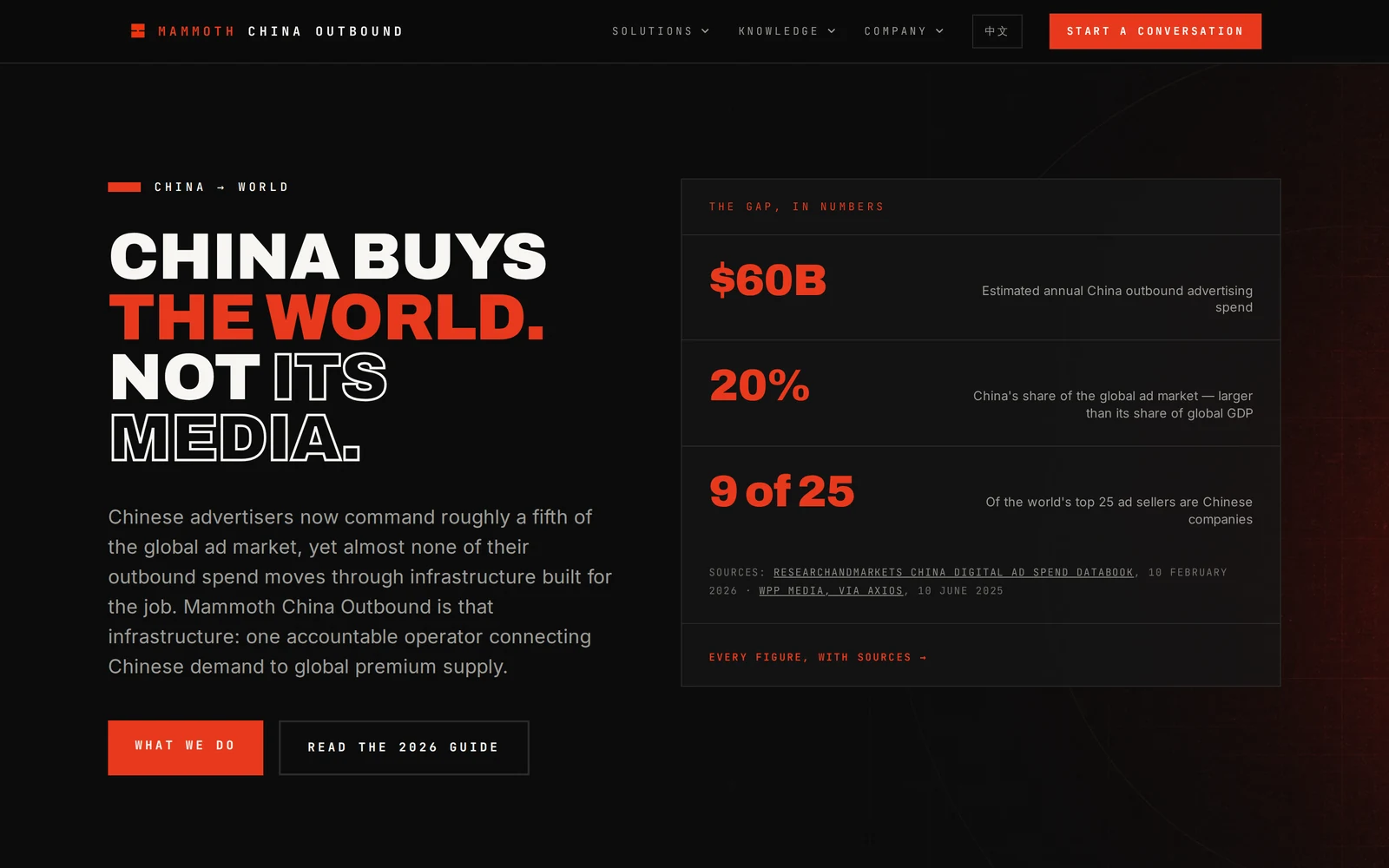
Talent, media & capital — wellness sectorCornbread Hemp, Seed Health, Beyond Aero, iHeartMedia02Mammoth China Outbound
Cross-border media infrastructureInvestor-grade positioning for a $163B market03Golfinity
Indoor golf performance club — AustinLocal answer-engine and near-me visibility04FabriCare of Greenville
Family-owned service architecture — South Carolina39 pages, 8 services, 6 delivery cities, 3 store pagesAIGNCI publishes no testimonials it cannot attribute to a named person at a named company. In a category full of initials and stock photography, that is a differentiator.
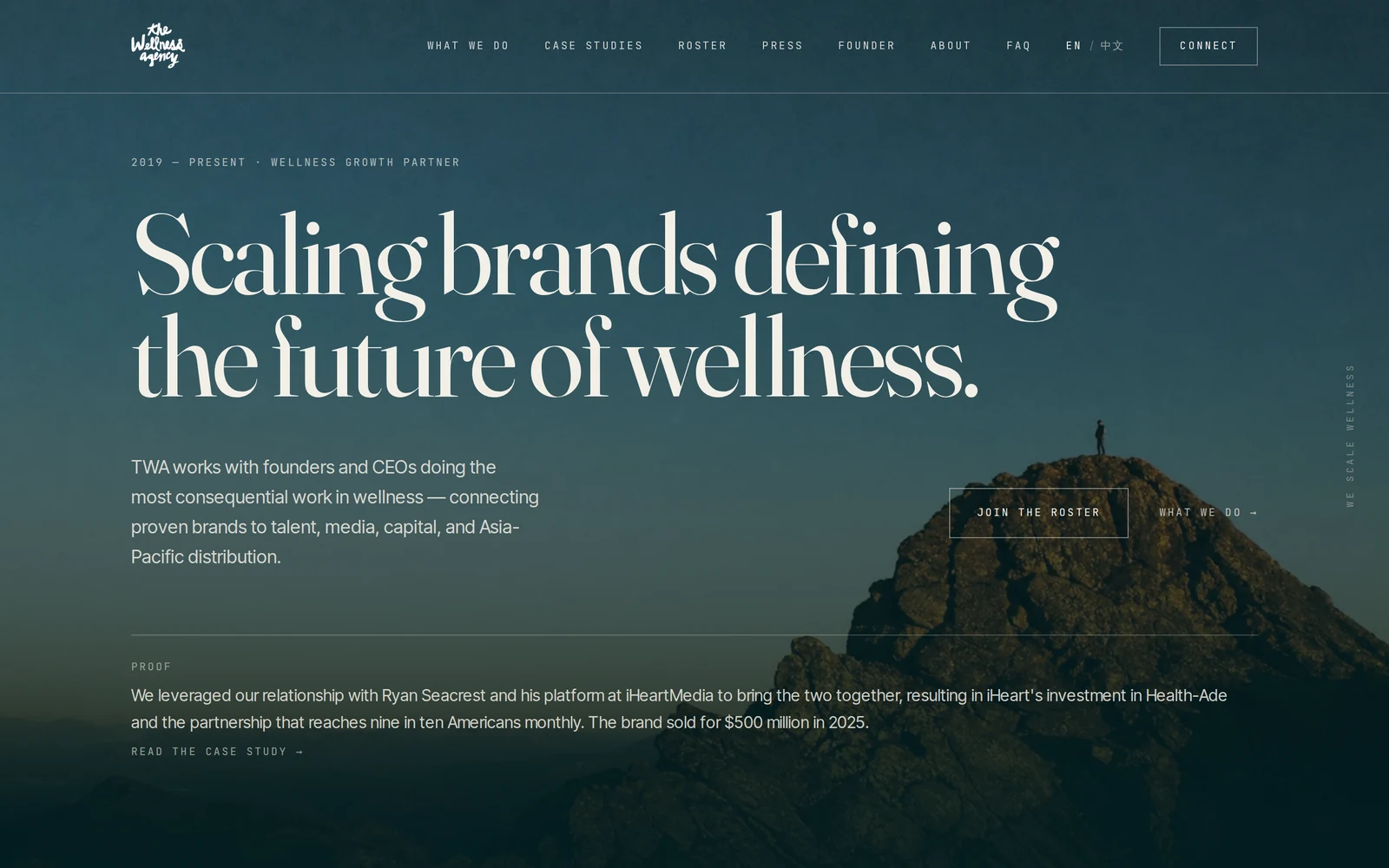
Answer engines weight what third parties say about an entity far more heavily than what the entity says about itself. These are companies on our clients' active rosters, with the fact that makes each one citable — every one checkable against a named publication.
Health-Ade
Sold for $500M in 2025
Source: The Wall Street JournalCornbread Hemp
#1 fastest-growing hemp company in America
Source: Inc. 5000Beyond Aero
$20M Series A, January 2025
Source: Robb ReportWisdom Ventures
$77.7M fund raised
Source: The Wall Street JournalPotato Head
#21 resort in the world
Source: Wallpaper*iHeartMedia
#1 audio company in the United States
Source: iHeartMediaTo be precise about the relationship: these are clients of The Wellness Agency, whose web presence AIGNCI builds and maintains. AIGNCI claims the build, not their outcomes.
AIGNCI built us a bilingual site that argues for itself. Named clients, sourced press, five practices with five clear paths — no adjectives doing work that evidence should be doing.
Published, because you should not have to ask.
Four of the ten most-cited agencies in this category publish pricing. The rest make you book a call to find out whether you can afford them. We think that is a tell.
Full pricing detail| Engagement | Built for | Investment |
|---|---|---|
| The AIGNCI Introductory Audit | Anyone starting cold | $5,000 |
| Citation Authority | Brands competing on category credibility | $4,500—6,500/mo |
| Category Leadership | Brands that intend to lead their category | $8,500—14,000/mo |
| FoundationSMB | Local & owner-operated | $2,500/mo |
| Citation-Ready Remediation | Existing platform, delivery failure | $15,000 |
| Citation-Ready Website Build | New delivery layer, built to be cited | $45,000 |
All retainers month-to-month · Diagnostic credited toward any retainer within 30 days
This site is the case study.
An agency that sells answer-engine visibility should be able to demonstrate it on its own domain. So everything we recommend is implemented here and open to inspection: a complete schema graph with resolved Organization and Person entities, semantic URLs, answer-first content structure, a published crawler access policy, and an llms.txt that actually describes the business.
Every statistic on this site carries its source. Every case study names its client. Every price is published. If you are evaluating agencies in this category, use that as your checklist — on us, and on them.
The questions behind an inquiry.
Companies do not come to AIGNCI because they need more content. They come when the market cannot find them, cannot understand them, or has no reason to choose them.
The operating question changes by market. The discipline does not.
Bring the problem you are trying to solve. We will start with the evidence.
Start a consultationTell us what you are building.
If the question is about discovery, reputation, a new site, or a market move, send the context. AIGNCI will tell you whether an Audit, a build, or a more focused engagement is the right starting point.